

Importance of Dry Manure Bedding
Bacteria need three things to thrive: moisture, heat and food (organic matter). Remove any one of these three sources and you will greatly reduce the ability of mastitis-causing organisms to survive and ultimately reduce somatic cell count. Dry bedding hinders the growth of mastitis-causing pathogens that are harmful to a cow’s health and can increase somatic cell count. Healthier cows result in higher overall milk production and have a longer lifespan.
Manure solids are a leading bedding type among dairy farms in the United States. They are readily available, making this a cost-effective choice that can be recycled, reducing environmental impact. Manure solids bedding is soft, comfortable and provides a thermally warm place for cows to rest during cold winter temperatures. On the other hand, manure solids are organic, so there is a potential for bacteria to grow and impact udder health and somatic cell count. They require an intense management program and are harder to keep dry, since wet material must be removed frequently. New bedding must be added at least daily to limit bacterial growth and keep stalls dry. That’s why it’s so important that dairy farms thoroughly dry manure solids before using them as bedding material.
Dry manure bedding slows bacterial growth and will absorb more moisture after it’s in the stalls, keeping cows drier, longer. Dried manure solids should be used immediately; no stockpiling is necessary. Freestalls bedded with drier manure bedding, compared to manure solids bedding with higher moisture, results in healthier cows with higher milk production and lower somatic cell counts.
After separation to remove most of the liquid, manure solids can be naturally dried through processes like windrowing or composting. Due to the conditioning necessary, these processes can be more labor intensive and take longer for the manure solids to be ready to use for bedding.
In addition to naturally drying manure solids, there are three main ways to mechanically dry manure solids. This equipment includes a screw press, a roll press or a bedding dryer. Mechanically drying manure solids will require less time, labor and storage space on the dairy.
Screw Press
Screw presses are compact separation and dewatering machines. They contain a rotating screw shaft within a screen. Screw presses can be used as a stand-alone piece of equipment or in system.
How Screw Presses Work
As material is conveyed into the body of the machine, the screw advances it forward past the screening surface. Fibers that are captured on the screen are wiped off and advanced forward by the screw. As these fibers accumulate at the discharge, they form a “plug” of material that is highly compressed and dewatered. These versatile separation machines provide great separation in a compact footprint. Due to high tolerances and high-pressure zones, they are prone to abrasive wear.
Roll Press
Roll presses reduce the moisture content of the removed fibers from the primary separator. They are often used as a secondary step and in combination with a rotary drum separator to dewater manure fibers due to their small screen and relatively low capacity. Roll presses have slow operation and high-pressure points which produce a highly dewatered product that is readily stackable and easily transportable. This secondary dewatering device is used in place of a screw press where abrasion is a concern, such as dairies that use sand bedding.
These are simple to operate and maintain and can be designed in multi-stage options, depending on the dry matter required. Besides manure fibers, roll presses have been used to dewater plastics, organic sludges, paper pulp, fiberglass, wet leaves and nut hulls.
How Roll Presses Work
Wet materials are fed into the top of the press, onto the first press zone. The rotational movement of the drive roll pulls the material through the press zone. Extremely high pressure is applied across a very small area called a rip point. High pressure at this rip point squeezes a portion of the liquid out from in and around the fibers and forces it through a screen, while the dewatered fibers continue to rotate with the drum and are mechanically removed by a scraper or a rotating brush.
Bedding Dryers
Bedding dryers are well-suited for a wide variety of applications. Bedding dryers work quickly, processing up to 5 tons of manure solids per hour, giving dairies cleaner, drier bedding without the labor and expense of mechanical conditioning. Bedding dryers can operate on a variety of fuel sources including natural gas, propane, diesel and biogas from a digester. Some of the many materials that can be dried with a bedding dryer include manure solids bedding, sand bedding, paper mill sludge, organic material and chicken litter.
How Bedding Dryers Work
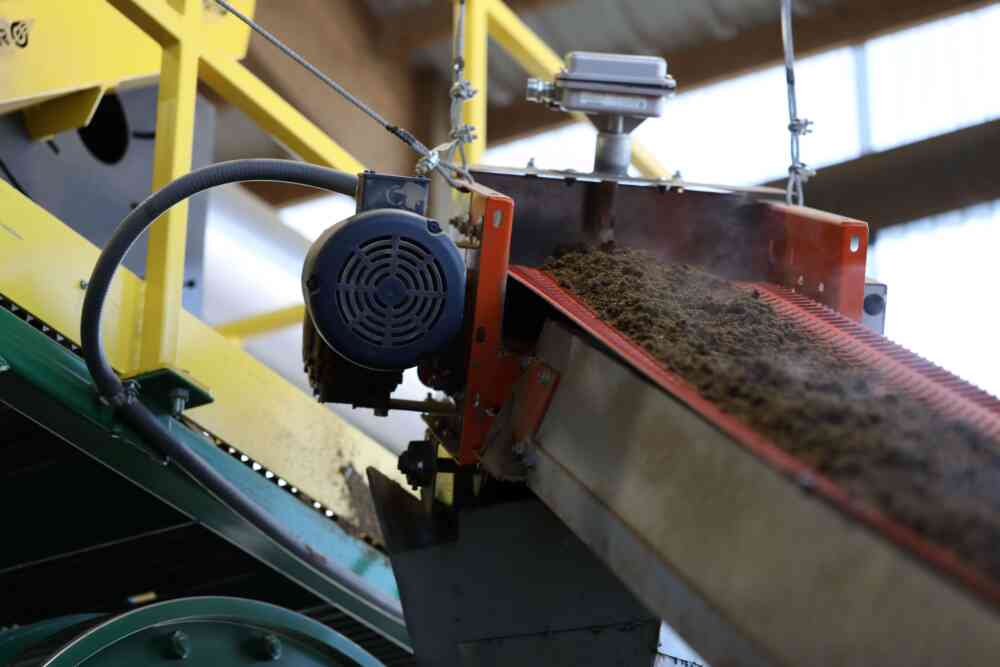
Using rotary drying technology, bedding dryers remove moisture from recycled bedding, killing harmful pathogens and decreasing their ability to grow, ultimately reducing somatic cell count. Manure is first dewatered with a screw press to create a fiber product that is about 70% moisture. The dewatered fibers are loaded into a hopper which is metered into the dryer and just enough moisture is removed to create an ideal bedding that contains fewer pathogens and that is more comfortable for the cows. Wet bedding is introduced into the system along with heat and air. As the material tumbles through the bedding dryer, heat and air pull the moisture out. The drier product is collected at the end, while the air and moisture are exhausted. At the discharge end, a conveyor system is used to move and stack the dried bedding. The manure solids can be used underneath the cows right away.
Dry manure bedding is a critical factor in maintaining cow health, improving milk quality and boosting overall herd performance. By reducing moisture, bacterial growth is limited, somatic cell counts are lowered and cows have a cleaner, more comfortable environment. Whether the choice is natural drying methods or investing in mechanical solutions like screw presses, roll presses, bedding dryers, or a combination of equipment, the goal remains the same: drier bedding leads to healthier cows and higher milk production.


