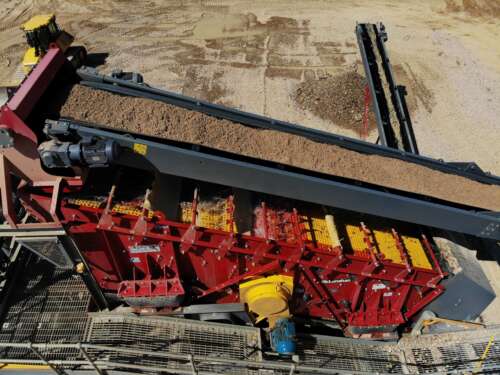
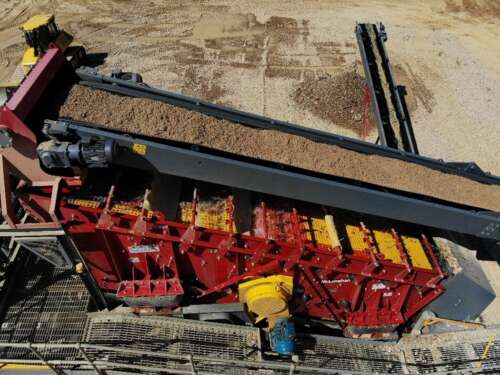
The aggregate industry produces a variety of materials that are essential for concrete production, road construction and creating everyday products. With the demand for high-quality construction materials rising, every stage of the aggregate production process is vital, especially screening.
What is Aggregate Screening?
Aggregate screening is the process of separating materials by size using specific types of screens. Different screening equipment works together to filter material based on its size, shape and abrasiveness. Whether it’s crushed stone, sand, or gravel, screening is conducted in several stages to improve the materials quality and size consistency.
The overall goal of this process is for materials to pass through a screen with openings so that particles smaller than the opening fall through. This allows larger particles to continue to move along the deck for further processing.
Conventional Screening vs. Probability Screening
When it comes to aggregate production, the approach to separating material is crucial for screening efficiency. Conventional screening and probability screening are two techniques that separate materials based on deck lengths, vibration frequencies and screen size openings.
Conventional Screening
Conventional screening is a method used in most aggregate processing applications for dry or moist materials. It focuses on the stratification of the material bed and uses inclined and horizontal vibrating screens to separate material. This means that material is fed onto the screen and moves across the deck from vibration. Larger particles mitigate to the top of the material bed while small particles filter towards the bottom of the screen to pass through the screen media.
Probability Screening:
Probability screening is designed to efficiently separate fine materials to produce greater product quality. It focuses on increasing the chances of fine particles passing through the screen by using smaller openings and giving material several opportunities to be sorted and sized. Because of this, oversized particles are immediately removed from the operation.
Probability screening feeds fine material vertically through steeply angled screen decks. The fine material glides through larger openings on the upper deck and will continue to pass through lower decks with smaller openings to achieve ideal separation. Using this technique allows material to process through the screen at a faster rate.
Understanding the Mechanics of Screening
In order to achieve maximum efficiency during the screening process, there are a number of mechanics that influence the performance of a screen.
Vibration Mechanisms
The vibratory motion of a screen is what causes the material to progress across a screen's surface from beginning to end. Vibration generates stratification as the movement separates particles, layering the larger particles on the upper deck and the smaller particles on the lower deck. There are several types of vibratory motions, including circular, linear and elliptical motions. Without vibration, the material would remain still on the machine and not separate.
Screen Speed and Stroke
The speed and stroke work together to control how fast material is vibrated and how far material travels across the screen. A high stroke and a low speed are best suited for coarse and wet material, while a low stroke and high speed are best suited for fine and dry material. The stroke is measured in inches or millimeters, and speed is measured in revolutions per minute (RPM).
Selecting the correct screen media is a very important aspect of the screening process because it ensures that each piece of material is separated according to the right size. The most popular types of screen media include woven wire cloth, urethane and rubber. Deciding on what screen media to use can make or break the entire operation, so it’s important to consider a material’s characteristics.
Types of Aggregate Screening Equipment
To successfully separate materials, a variety of screening equipment is used to meet the needs of various applications.
Some common types of aggregate screening equipment are:
MD Vibrating Screens
Multi-Deck (MD) Vibrating Screens are multiple screening decks that are stacked vertically at increasingly steeper angles. To separate materials, these types of screens use high frequency vibrations in linear motion to move finer particles through openings. Depending on the application, this type of screen can operate with up to five screen decks and handle feed sizes as large as three inches.
McLanahan offers three models of MD Vibratory Screens, including:
- Type DM
- Type SM
- Type DMX
Inclined Screens
Inclined Screens are vibratory screens and are the most popular type of screen. There are several models of inclined screens, including two and four bearing, high-speed and high frequency screens. To operate, this screen has a tilted screen deck that uses a combination of circular vibratory motion and inclination to guide materials.
The screen is mounted on springs and is typically powered by an electric motor. For optimizing performance and efficiency in any application, inclined screens can be easily adjusted in slope, speed, stroke and direction of rotation.
Horizontal Screens are flat vibrating screens with a linear or elliptical vibration motion. This screen works by feeding material evenly across the horizontally positioned screen deck. Horizontal screens are more efficient than inclined screens because they have a slower travel speed that allows material to stay on the screen longer, resulting in a more accurate separation.
One of the most beneficial features of horizontal screens is the amount of aggressive force the screen generates to dislodge particles, which prevents blinding and plugging. Horizontal screens can adapt to specific applications and produce more consistent material compared to inclined screens.
Common Equipment Challenges
Many challenges can surface throughout the screening process, impacting the product's quality and efficiency. Two of the most common challenges are blinding and pegging.
Blinding occurs when static energy in a particle sticks to the screen media, causing buildup that prevents the remaining material from passing through the screen. Pegging happens when a particle becomes wedged and stuck in the wires of the screen media. This results in improper separation of materials, which could lead to bigger problems that affect the entire operation.
Be sure to evaluate your material consistency, operational requirements, spacing and application needs to help you determine the right screen for your aggregate processing operation.