

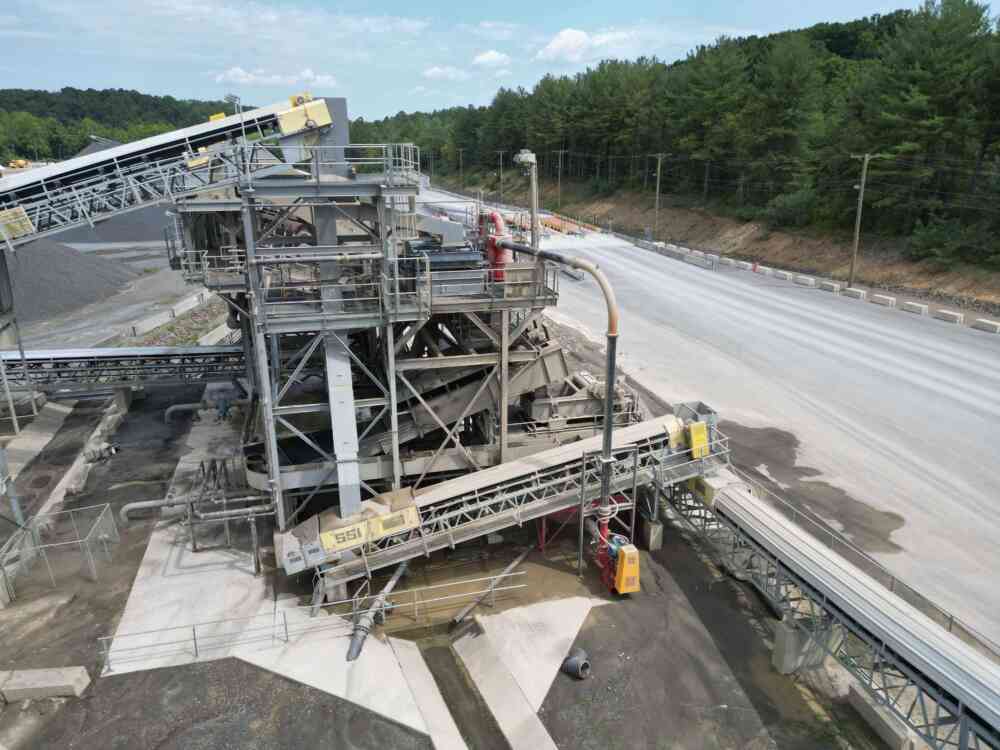
Fine Material Screw Washers are a popular choice for washing and classifying sand. They can be used as a stand-alone machine or as part of a larger wet processing plant.
Also called sand screws, Fine Material Screw Washers are well-known and have been proven over decades for processing a variety of materials. The machines are easy to operate and produce an in-spec product that is conveyable and stackable.
However, these machines can be inefficient as product-sized fines can be lost to the waste stream. This usually occurs if there is a change in the flow that exceeds the screw’s design limits. A change in the feed, whether it be in the number of solids or water volume being added, can cause this loss of fines.

Solving Feed Variances
Option 1 – Increase The Size Of Your Screw Washer
One way to account for the change in feed and recoup the lost material is to increase the size of your screw washer. Screw Washers must be sized for both the solids and the water in order to operate most efficiently and to provide the most effective separation.
Option 2 – Add A Scavenger System To Recover Fines
Rather than sizing up your machine to handle the increased slurry feed, you can add a Scavenger System to recover product-sized fines from the waste stream and put them back into your product pile. Not only will this lessen the amount of material filling up your settling pond, which will reduce required pond maintenance, it will also increase the amount of material in your product pile.
Say you can recover 5 tons per hour of material from the waste stream using a Scavenger System. If sand costs $20 a ton, you can make an additional $200,000 in a typical 2,000-hour operating year. This doesn’t include the savings from reduced pond maintenance, which can include both excavation equipment costs and labor costs.
What is a Scavenger System?
A Scavenger System consists of a Pump, Sump and a Separator™. The system receives the flow from the waste stream, removes the good fines and deposits them back into the product pile.
Scavenger Systems can be used with many types of classification equipment to improve efficiency, but they are most commonly used in conjunction with Fine Material Screw Washers.
These systems ensure your material is going to the right place, where it can make you the most money at the end of the day.
How does a Scavenger System work?
- Capture The Slurry: In a screw washer application, the overflow from the weirs is directed to a sump instead of the pond.
- Pump The Slurry: The slurry is then pumped from the sump up to the Separator™, which is installed over the dry deck area of the screw washer near the discharge end.
- Recover The Fines: A Separator™ can be configured for higher classification efficiency to recover product-sized fines while discarding unwanted fines. The product-sized fines are then discharged onto the Fine Material Screw Washer, where they combine with the product before it is discharged for stockpiling.
- Downstream Processing: The remaining ultra-fine material and water in the slurry exit via the overflow pipe of the Separator™ and are sent to waste or additional processing equipment, such as an UltraFINES Recovery Plant.
Benefits of Adopting a Scavenger System
Operators of wet processing equipment should periodically sample their waste stream to determine the efficiency of the machine(s) in their plant.
Scavenger Systems can be helpful for operations that have a large percentage of minus 200 mesh (or 50 by 200 mesh) material present in the overflow that should be going to the product pile.
McLanahan’s process engineering team can analyze your feed gradation and the number of solids in the overflow to determine if the fines can be recovered without throwing your product pile out of spec. If adding the recovered material to your product pile is determined to be a benefit, the team will size a Scavenger System specifically for your application.
Benefits Of Including A Separator™ In Your Operation
The speed of a Fine Material Screw Washer vastly affects its ability to process a fine feed. For example, a screw processing minus 50 mesh will operate at a faster speed than a screw processing minus 200 mesh. In this example, the slower screw can’t process the same tonnage.
The ability to remove the finer material prior using the underflow from a Separator™ will allow the Fine Material Screw Washer to achieve a higher speed with more tph as the finer minus 200 mesh product has already been removed from the screw feed by the Separator™ before it enters the screw.


