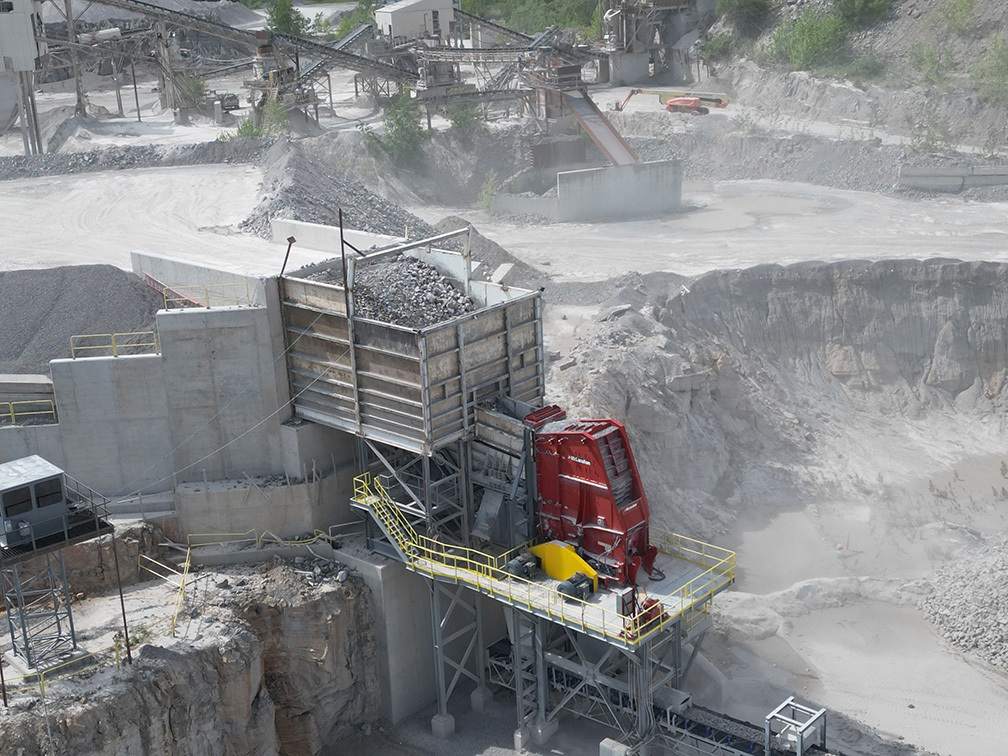
Hastie Mining LLC was founded in 1965 by brothers Robin, Donald and Robert Hastie. Located in Cave In Rock, Ill., near the Ohio River, Hastie processes limestone and Rosiclare sandstone to make crushed stone, ag lime, rip rap and fluorspar.


Hastie Mining LLC was founded in 1965 by brothers Robin, Donald and Robert Hastie. Located in Cave In Rock, Ill., near the Ohio River, Hastie processes limestone and Rosiclare sandstone to make crushed stone, ag lime, rip rap and fluorspar.
Hastie Mining built a primary plant in the 1980s for its skid rock operation. As the company expanded more into the limestone business, it brought in a few portable plants to help bridge the production gap. However, even with the addition of the portables, Hastie still wasn’t getting the capacity it needed. The company decided it was time to invest in a stationary primary crushing plant that would increase tonnage while decreasing operational costs.
Calling on long-time dealer, Continental Equipment Company, McLanahan’s distributor for dry processing equipment in Illinois, Hastie began the process of designing its new plant. Continental recommended McLanahan’s newly redesigned MaxCap Impact Crusher, re-engineered for increased durability and productivity. Hastie already had a McLanahan Secondary Impact Crusher dutifully operating since 2015, so the company was aware of the reliability McLanahan equipment offered.
“We’ve had really good luck with it over the years, so really that part of the experience we’d had with McLanahan before we decided to get the primary is one of the big reasons why we decided to go with McLanahan in the end on this big project,” shared Plant Manager Rodney Lane, a member of the third generation of the Hastie family.
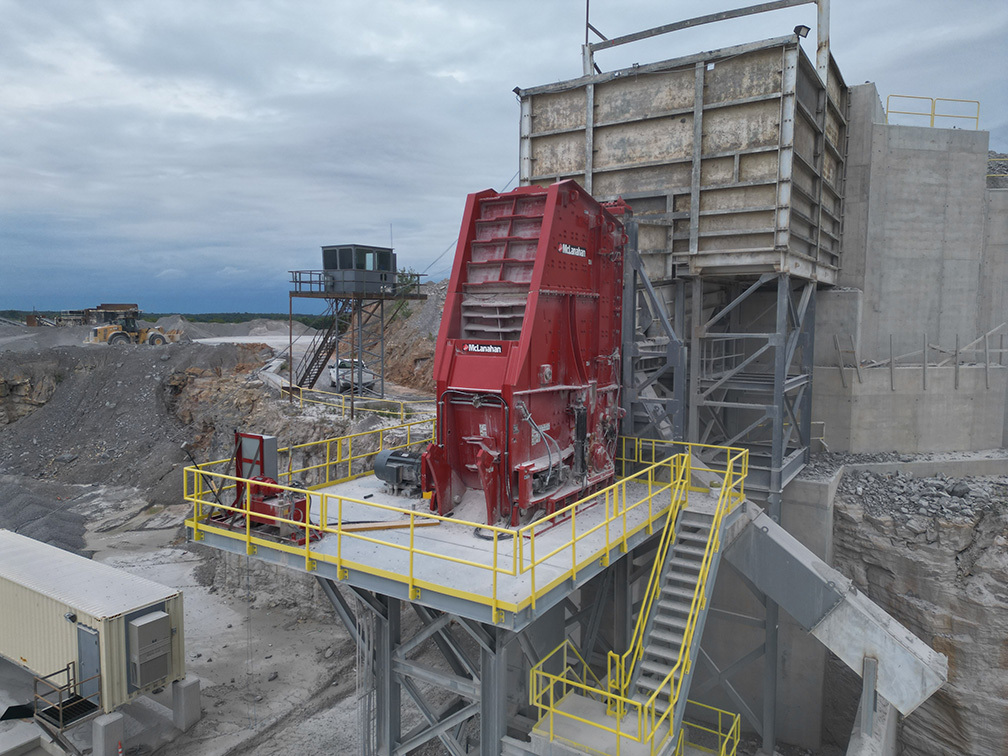
In late 2025, Hastie Mining installed a McLanahan MaxCap 1650 Primary Impact Crusher. The MaxCap design is a combination of well-known impact crusher styles, featuring a large expansion chamber indicative of the New Holland type crusher — a design that Hastie Mining was familiar with and liked, with the ease of maintenance common to Andreas type crushers. The 1650 model boasts a 65” wide feed opening and can process up to 1,650 tons per hour, discharging at 6” minus.
Throughout the sales and startup process, Hastie worked closely with McLanahan and Continental Equipment.
“From the very beginning, from the time we ordered the crusher,” Lane said, “everybody worked together really well. That made the process way easier. When it finally came time to install it, that process was just seamless because of all the help that they gave us before that.”
McLanahan was also on site for startup to provide the Hastie Mining team with operational and maintenance training.
“They came down, they went through everything that we needed to know, made sure that we knew everything that we needed to know, and have been very supportive from that day since,” Lane shared.
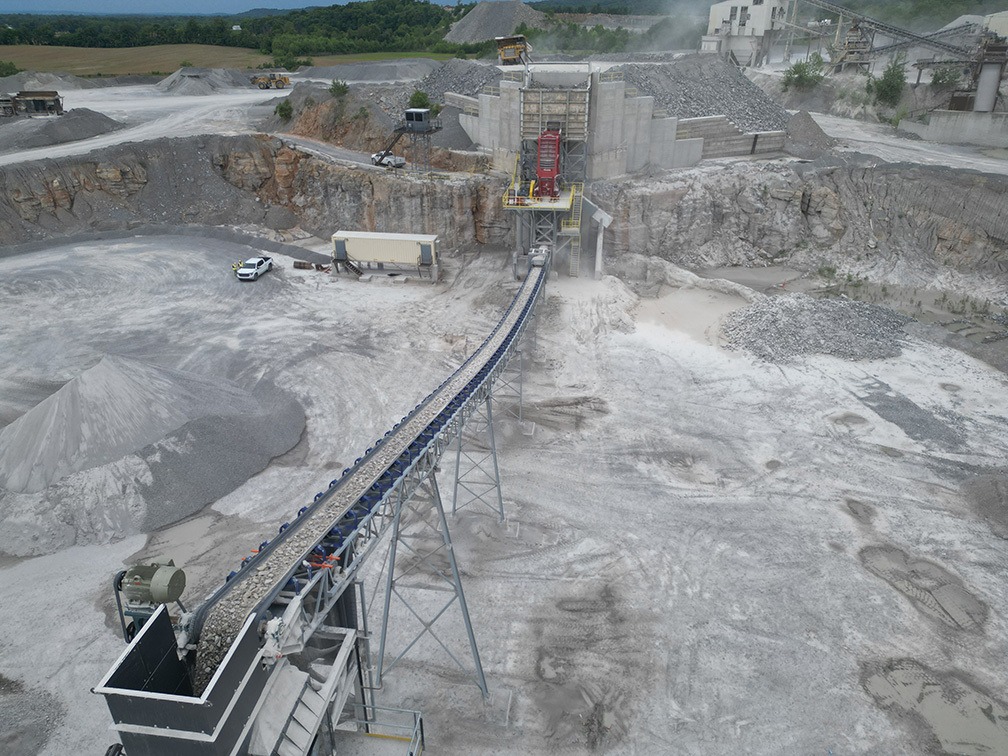
The McLanahan MaxCap 1650 Primary Impact Crusher has exceeded Hastie Mining’s expectations, especially when it comes to wear life.
“Every part of wear has been better on the McLanahan than we expected by far,” Lane said.
Operations Manager Ryan Watson shared that Hastie Mining has yet to flip or change the blow bars on the MaxCap rotor, a maintenance task that is required when the blow bars have worn to maintain product quality, consistency and efficiency. This is a big change from biweekly blow bar changes on the company’s previous impact crushers, which took the better part of a day to replace. Besides the blow bars themselves being an expensive wear item, the downtime and labor were also costs that quickly added up with the frequent replacements.
“The MaxCap 1650 blow bars have not been wearing bad or not been breaking like we’ve seen in previous impactors, which has drastically lowered our repair costs as well as keeping the machines running,” Watson said.
In addition to increased wear life and the crusher’s heavy-duty build for improved productivity, the MaxCap 1650 was engineered with safety and ease of maintenance in mind. Among the MaxCap 1650’s safety features are a rotor lock to prevent movement of the rotor during blow bar changes and hydraulic hood locks to keep the crusher closed during operation.
“The hydraulic hood locks on the MaxCap 1650 are great,” Watson said. “They will not let the lid be open if the locks are on, and you cannot start the crusher if the locks are not on, so they will not come open.”
Watson added that the safety features of the MaxCap give Hastie a sense of comfort.
“In this industry, things are very dangerous, and there are a lot of safety features such as the rotor lock on it as well as the hydraulic lockouts on it,” Watson shared. “It gives us peace of mind that the guys, you know, cannot be crushed or hurt from the lid being shut or the rotor spinning.”
Both Watson’s and Lane’s favorite thing about the McLanahan MaxCap 1650 Primary Impact Crusher is what drove them to purchase it in the first place — the reliability.
“The reliability of the McLanahan 1650 has been excellent so far,” said Lane, “and reliability is, you know, dollars in everybody’s pocket here. The main reason, the main goal for this project was to get man hours down, cost per ton down, and so far, the McLanahan 1650 has done just that.”