


One of the most effective ways to reduce mastitis risk, improve cow comfort and improve milk quality is by keeping bedding sand clean and dry. Excess moisture in recycled sand creates an ideal environment for bacteria to grow, which poses increased herd health risks and operational costs. By dewatering sand before it is returned to freestalls, dairy producers can achieve better cow health while improving efficiency in their sand management system.
A variety of sand separation and cleaning technologies have been used to separate and clean sand that has been used for freestall bedding. These techniques rely on gravity and sometimes centrifugal forces, or maybe a combination of the two, to differentiate sand from the water and other particles in the manure. It’s fairly common that a properly designed sand separation system can recover up to 90% or more of the bedding sand from the manure. This recovered bedding sand contains varying amounts of moisture and is usually stacked and allowed to dewater for weeks or months before reintroducing back into the stalls. During this time, money remains tied up in sand inventory.
The Value of Recycled Sand
Allowing sand to dewater naturally may seem simple, but it comes at a cost. When sand is stockpiled for extended periods, producers are essentially paying for bedding material that is not immediately usable. Large sand piles also require significant storage space and frequent handling. Each additional day sand remains unused contributes to lost opportunities, increased labor expenses and additional sand purchases.
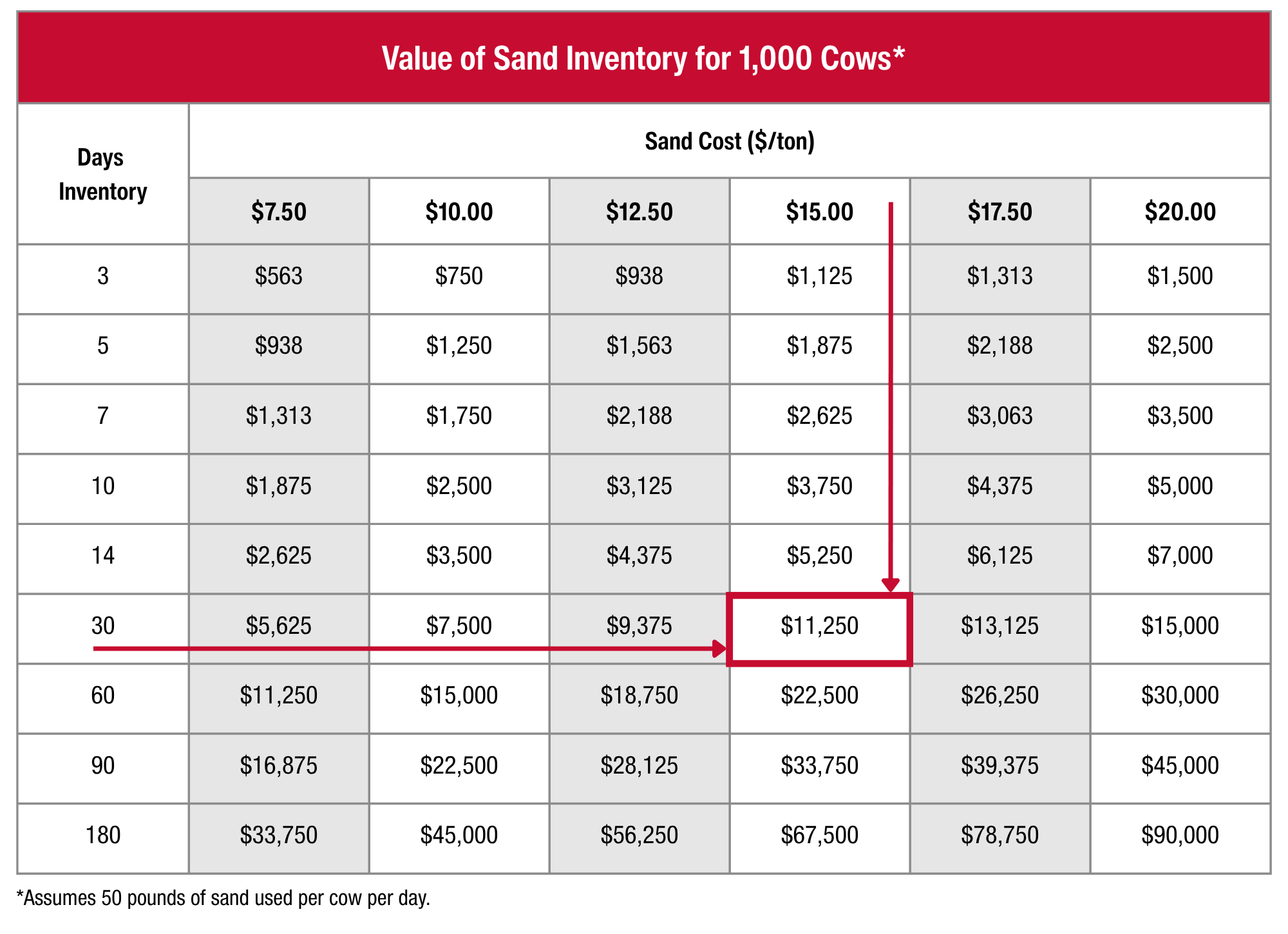
This table represents the value of sand inventory for a 1,000 cow herd paying $15/ton of sand and allowing it to dewater for 30 days. There is a substantial amount of money tied up in unusable inventory during that time.
In addition to the financial impact, sand piles must be moved and restacked multiple times to facilitate drainage, requiring additional equipment use, fuel and labor hours. In most regions, regulations require that the sand is stacked on a concrete pad so the leachate can be collected and diverted to the manure storage(s).
Benefits of Dewatered Sand for Dairy Farms
An alternative to long-term stockpiling is mechanically removing water from the sand immediately after it comes off the sand separation system. This can be accomplished with a Shaker Screen, also known as a Sand Dewatering Screen. Shaker Screens mechanically remove free water from the sand and produce a drip-free sand product that is commonly reused within several days.
One of the most obvious benefits of mechanically dewatering sand is the immediate reduction in moisture. Separated bedding sand typically contains 20-30% moisture as it comes from the separation process. Immediately putting that sand through a Dewatering Screen reduces the moisture content to as low as 7-9%. This yields a sand product that will readily stack with minimal water leaching from the pile.
The sand coming off a Shaker Screen can often be reused immediately. There is no need for large stacking areas to contain the recycled sand and leachate. The sand also needs little or no conditioning, which means less operator interface. All this equates to reduced handling time and a reduction in new sand purchases.
The benefits of dewatered sand go further than just having drier sand, less inventory and smaller stacking areas. As water travels out of the sand, it carries with it fine manure particles – measured as volatile solids (VS). These manure fibers act as sponges, which hinder dewatering and become the food for any bacteria that may be in the sand. Sand that is mechanically dewatered is not only drier, it is also cleaner.
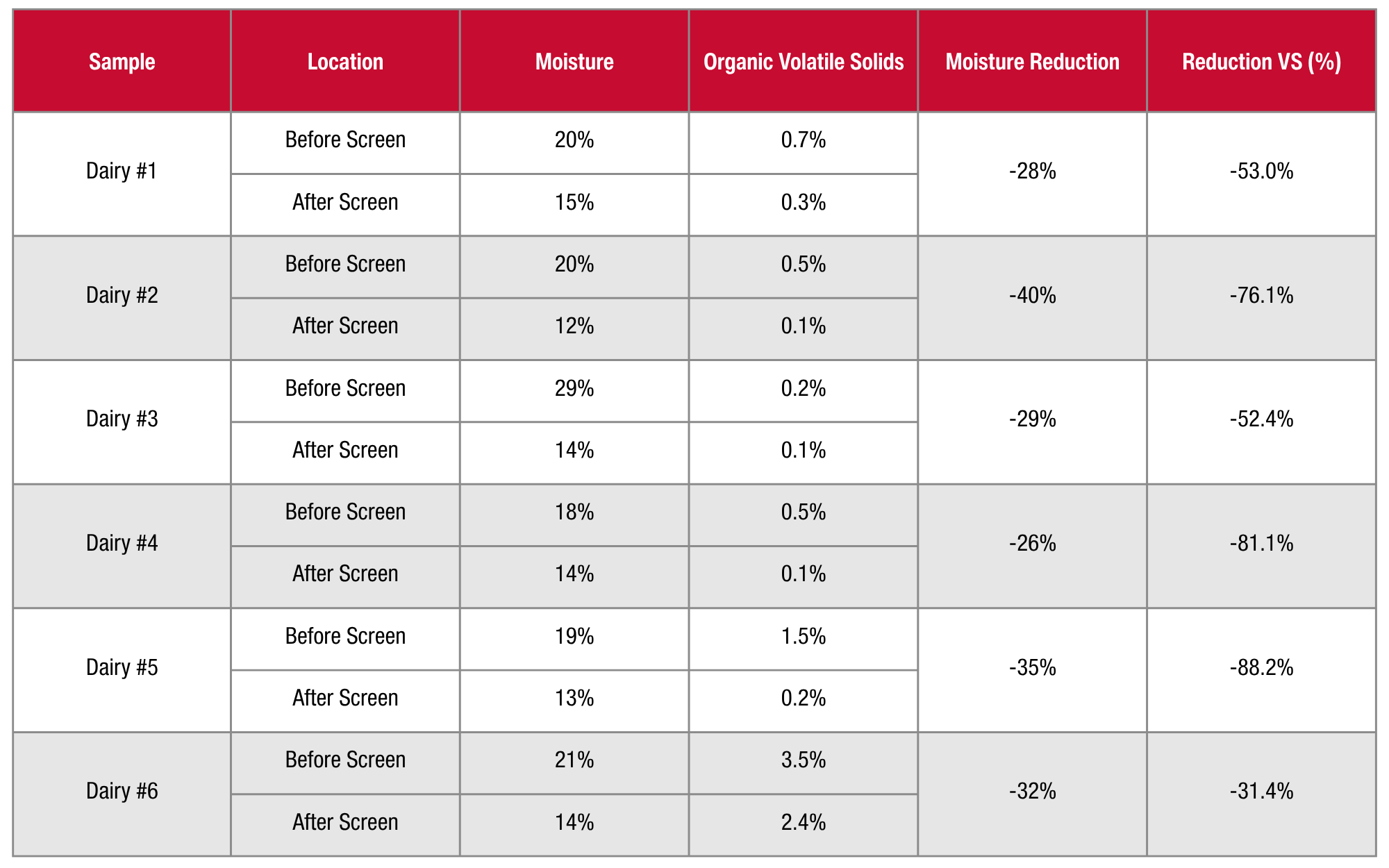
This table shows the results from six different dairies using a Shaker Screen after sand separation. Before screening, the average moisture content was 20% and the volatile solids were 1%. Following screening, the average moisture dropped to 14%, which is an average reduction of 32%. At the same time, volatile solids dropped an average of 64%. Visually, the dewatered sand piles produce little or no leachate.
How Shaker Screens Work
A Sand Dewatering Screen contains an inclined vibrating screen deck. Wet sand is fed onto the screen deck, which is inclined toward the discharge point. Two counter-rotating motors create a linear motion to the deck, which throws the sand uphill toward the discharge. As the sand is accelerated up and forward, water and fines begin to drain through the sand and screens. This motion rapidly repeats itself, causing the sand to move toward the discharge. A discharge weir at the end retards the sand and determines the bed depth. The dewatered sand discharges over the weir, while the separated liquid is directed away.
Dewatering screens are available in a range of sizes to match system capacity requirements, with the largest screens capable of more than 200 tph. These capacities are dependent on the type of sand being processed. Sand composed of larger particles will dewater faster and easier than sand composed primarily of small particles.
Who Can Benefit from a Shaker Screen?
Any dairy producer who beds with sand and manages a sand separation system can benefit by adding a Shaker Screen to their system.
In a mechanical sand separation system, the sand is discharged from the sand-manure separator directly onto the screen deck of the dewatering screen. In a sand lane settling system, the sand is scooped up with a loader, which then feeds it directly into a hopper. A screw feeder would meter the wet sand onto the screen. If the sand has high organic loading, it could be washed with a sand-manure separator prior to dewatering.

The Positive Effects of Drier Sand
Shaker Screens can quickly and positively affect the recycled sand quality of a dairy by reducing the moisture and volatile solids content of the recycled sand. This leads to cleaner, drier bedding, reduced sand inventories, fewer labor interactions and smaller sand stacking areas. Ultimately, improved sand quality supports better cow health and enhances overall dairy operations, helping producers improve milk quality, boost efficiency and maximize the value of recycled sand.

