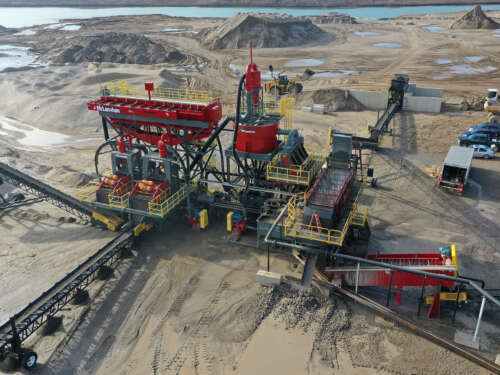
There are many equipment options available for washing, so when evaluating the correct equipment and process flow for your application, it’s important to first consider the type of contamination you wish to remove and the properties of the material.
Is the contaminant a tough, fine-grained, tacky clay that needs the aggressive scrubbing action of a Log Washer? Or is it a lighter, loamy type of clay or dirt and dust that can be removed with either a Coarse Material Screw Washer or a Rotary Scrubber? Once this has been determined, the proper equipment can be selected based on feed size, capacity and other key application factors.
McLanahan’s history of building rotary equipment and Log Washers dates back more than 100 years, and over that time, a strong application database has been developed. Let’s take a closer look at one of McLanahan’s wet processing machines, the Rotary Scrubber, and how it can be used in your washing circuit.

What is a Rotary Scrubber?
Rotary Scrubbers are often used following primary crushing and used to remove light, loamy type clays and other soluble, deleterious materials from feedstock, with sizes of up to 12” (300 mm). If the feed includes a tough, fine-grained, tacky clay, a Log Washer should be considered instead. This is because the tumbling action of the Rotary Scrubber can cause small clay balls to combine into larger clay masses as they exit the drum.
Key factors in selecting a Rotary Scrubber over other types of washing equipment include its ability to accept larger feed sizes and handle higher capacities compared to Log Washers or Coarse Material Screw Washers.
How Rotary Scrubbers Work
It is preferable that the –0.25” (6mm) fines fraction be removed before it is introduced into the scrubber. This can be accomplished through traditional screening methods or by adding a desanding section to the scrubber to remove a portion of the fines. By doing so, the scrubbing action can be more vigorous, rather than being cushioned by the fines fraction.

Fresh water and the material to be cleaned are introduced through the feed chute. As the cylinder revolves, the tumbling and cascading action of the aggregate against itself and the liners break down softer material and dissolve dirt, loam and other soluble material into the solution. This material can then be removed by a Dewatering Screen.
The rotating drum, which is fitted with lifter bars, works in conjunction with centrifugal force to carry the material partway up the side of the drum until approximately the 11 o’clock position before it is released and tumbles back down to the bottom. This continuous lifting and dropping action helps break down softer materials and separate contaminants as the slurry moves through the length of the cylinder.

Feed material is continuously lifted and dropped by the tumbling action of the cylinder.
It is recommended that lab testing be performed on the feed material, as each application is different. This helps determine the appropriate selection and retention time needed to achieve the desired level of cleanliness. In some cases, an adjustable weir at the discharge end of the cylinder can be used to help control retention time.

An adjustable weir can help provide the necessary retention time.
As the slurry exits from the Rotary Scrubber, it is often passed over a rinse or sizing screen. In certain applications, the scrubber can be equipped with a trommel screen extension and an internal spray bar to provide a rough sizing cut. This extension may be a single or double-shell design, allowing for multiple product-size separations. This screen media can be made from abrasion-resistant, perforated rolled plate, rubber or urethane screen panels. Depending on the application, however, a trommel extension may not provide the level of accuracy needed for precise product separation. Capacities of up to 2,500 tph can be achieved in a single Rotary Scrubber.
Once this process is complete, the washed material is ready for further downstream crushing or sizing.
If a Rotary Scrubber seems like a good fit for your application, read more about how McLanahan helped a Colombian processor with their challenges.